


Who really owns this business?

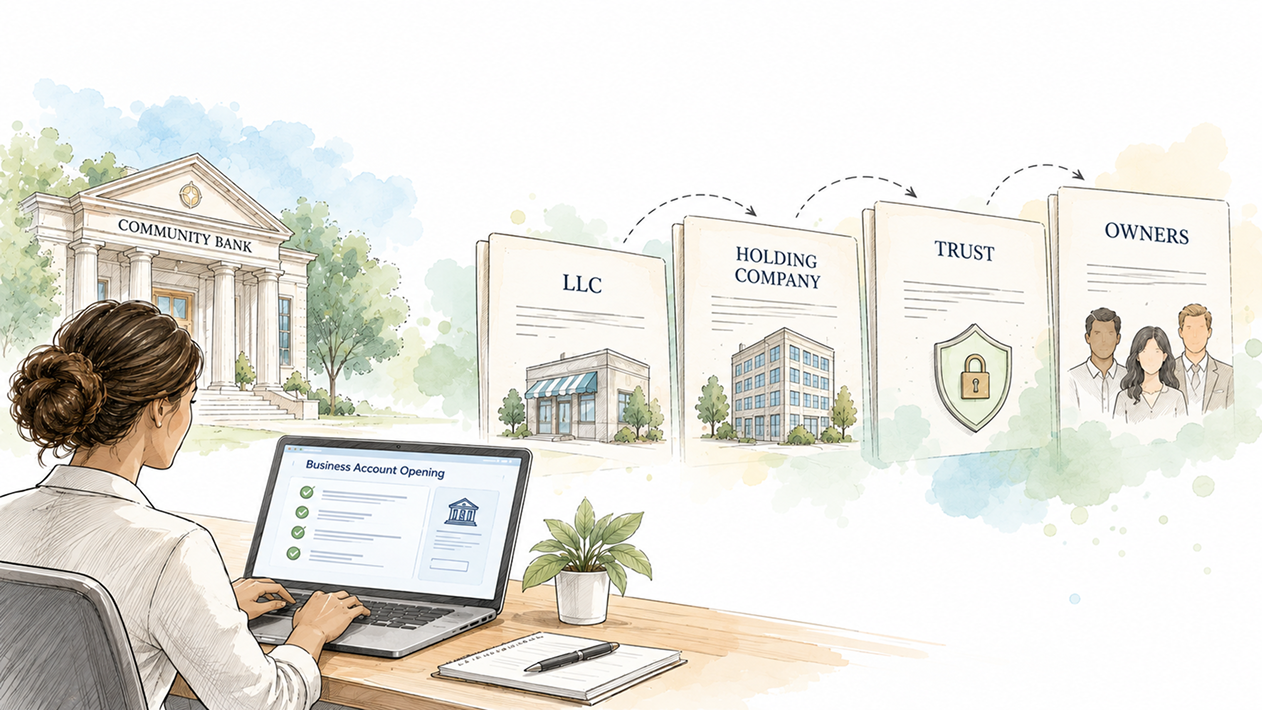
A business walks in to open an account. On paper, it is an LLC. Behind the LLC is a holding company. Behind the holding company is a trust. Behind the trust, somewhere, are the people who actually own and control it.
Finding them is someone’s job. At many community banks we talk to, that someone is a banker or a BSA analyst digging through layer after layer of ownership by hand: operating agreements, state filings, email threads, follow-up calls. At several banks, business account opening is still fully manual from start to finish.
It is slow. And slow is not the same as safe.
Fraudsters go where verification is weakest. For many banks, that is no longer the consumer account. It is the business account.
Most tools were built for consumers. Many onboarding platforms were designed around a retail account: one person, one ID, one form. Business accounts get treated as an add-on, a bolted-on module that verifies the person filling out the form, not the business behind it. The bank is forced to fit a commercial relationship into a consumer experience.
But the reality of business banking is completely different. A business has multiple owners, signers, and controllers. It has formation documents, state registrations, and ownership structures that can run several layers deep. When the system can’t see any of that, the bank’s team has to fill the gap by hand, and whatever they don’t catch becomes the opening fraudsters use.
Put together, the business account becomes the new front door for fraud.
Many banks keep business onboarding manual because it feels more careful. A person reviews every document. A banker knows the customer. But manual review has its own risks:
Commercial deposits are a top priority for almost every community bank we talk to. Yet the door for business customers is often the one most likely to say: come into a branch, or call a banker.
Modern KYB does not remove the banker’s judgment. It removes the digging, so the banker’s judgment goes where it matters.
The banker receives a complete file with the ownership structure mapped, the evidence gathered, and any issues highlighted. Clean applications move in minutes instead of days. Complex ones get the attention they deserve.
The question “who really owns this business?” should not depend on how many hours your team can spend digging. It should be answered the same way, every time, with evidence.
At Linker Finance, we built business onboarding for how businesses are actually structured: multiple owners, multiple layers, and real documents. Beneficial ownership, KYB, and sanctions screening are built into one flow, connected to the core you already have.
Want to see how one bank grew digitally without growing fraud? Watch Jorge Garcia, our Founder and CEO, on Sardine’s Fraud Forward series: How Vault.Bank Launched Digital Banking Without Launching Fraud.
If your business customers still hear “come into a branch,” let’s talk about opening that door safely.


